The Art of the Impression: A Guide to Sanganer and Bagru Hand Block Printing
In the heart of Rajasthan’s "Pink City," Jaipur, lies a textile heritage so vibrant it has colored the world for over 500 years. While "Jaipur block prints" is often used as a catch-all term, any true connoisseur of Indian textiles knows that this legacy is divided between two legendary villages: Sanganer and Bagru.
Though both share the same fundamental tools, hand-carved wooden blocks and the rhythmic thumping of the artisan’s hand, they represent two entirely different souls of craftsmanship. Here is everything you need to know about the fine florals of Sanganer and the earthy rhythms of Bagru.
A Shared Lineage: The Chhipa Community
The story of both traditions begins with the Chhipa community, a specialized community of printers whose name literally means "those who stamp or print". Many historians and artisan traditions trace the migration of Chhipa printers to western India, including regions of present-day Gujarat, between the 16th and 17th centuries.
Despite their shared roots, the geography of where they settled, specifically the availability and mineral content of local water, dictated the technical divergence of their crafts.
Sanganeri Print: Courtly Elegance and Fine Florals

Located just 16 kilometers south of Jaipur, Sanganer flourished under the direct patronage of royalty. Historically, Sanganeri textiles were widely favored for courtly attire, turbans (safa), and fine upholstery.
-
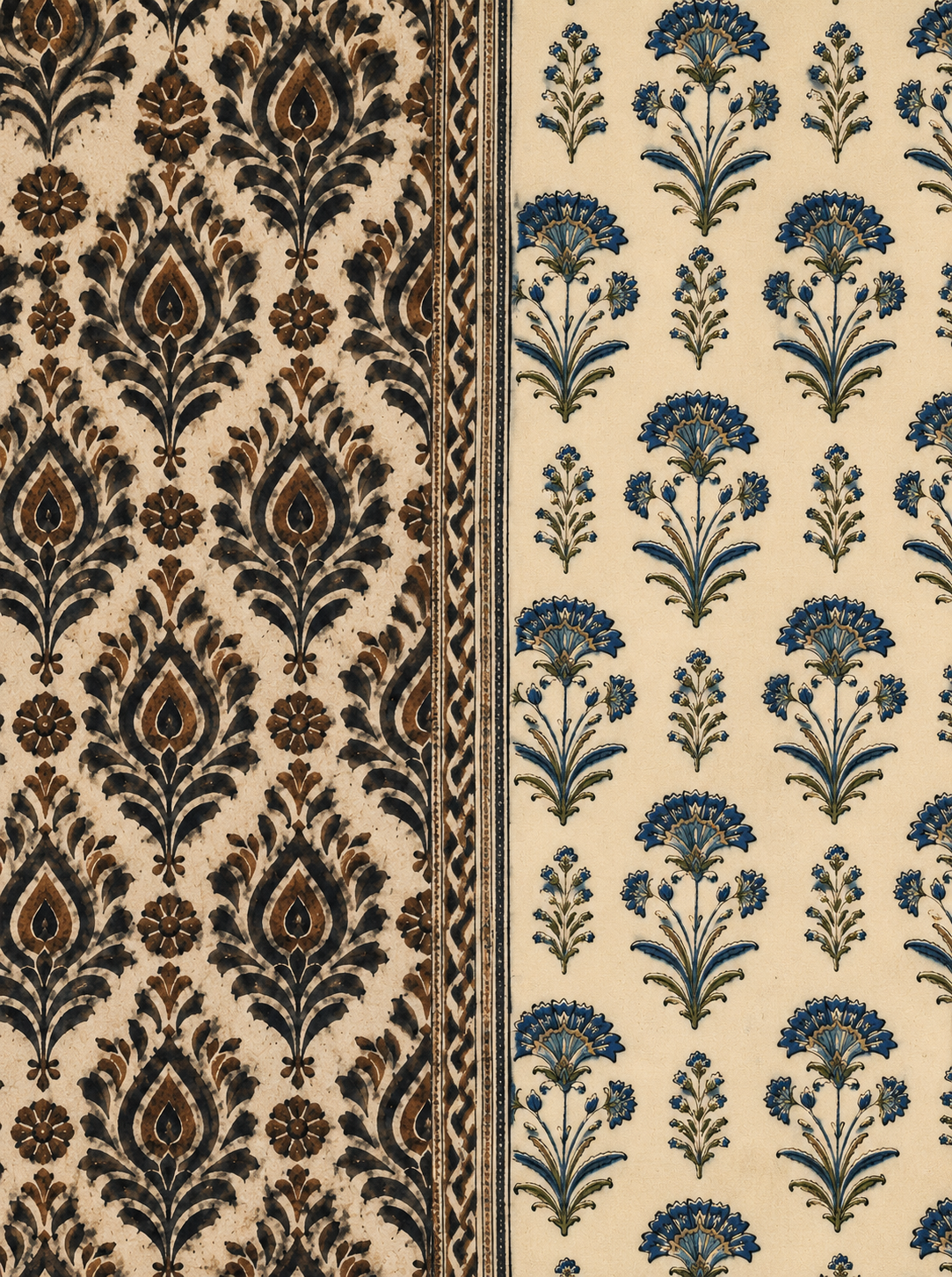
The Aesthetic: Sanganeri printing is defined by its delicate, intricate floral patterns and fine-line linework. These motifs are heavily influenced by Mughal aesthetics, often depicting non-native flowers like tulips, poppies, and irises arranged in graceful sprays.
-
The Signature Background: The hallmark of Sanganer is its stark white or cream background. Historical accounts often credit the local river water with helping achieve the bright whites and clear dye results associated with Sanganeri printing.
-
The Technique: Sanganer is especially associated with direct block printing onto fabric. Artisans apply dyes directly onto the fabric using high-precision blocks, requiring a steady hand to ensure "invisible" join lines where the patterns repeat.
Bagru Print: Earthy Rhythms and the Magic of Mud

Roughly 30 kilometers west of Jaipur, Bagru remained rooted in the rural landscape, traditionally producing textiles for agrarian and pastoral communities.
The Aesthetic: Unlike the refined elegance of Sanganer, Bagru motifs are bolder, larger, and more geometric. Designs often feature stylized indigenous flora and checks (chaupad), reflecting the rhythmic simplicity of rural Rajasthan.
-
The Earthy Palette: Bagru prints celebrate a rustic, organic color palette of indigo blue, madder red, and iron black set against earthy grounds of beige or ochre. These earthy tones are traditionally achieved using natural mordants, clay preparations, harda (myrobalan), and vegetable dyes.
-
The Dabu Mastery: Bagru is world-renowned for Dabu, a mud-resist printing technique. Artisans stamp a pattern using a viscous paste of black clay, lime, and gum, then sprinkle it with sawdust. When the fabric is dyed, the mud acts as a barrier. The signature "crackle effect", where dye seeps through tiny fissures in the dried mud, is a hallmark of authentic Dabu work.
Why Authenticity Matters
Today, both Sanganer and Bagru hold Geographical Indication (GI) status, legally recognizing that their distinctive qualities are rooted in local materials, traditional techniques, and generations of artisan knowledge.
In an era of mass-produced, digital imitations, genuine hand-block prints stand out for their character. You can often identify authentic hand-block printing through slight variations in color depth, visible dye penetration on the reverse side of the fabric, and faint join lines where a human hand, not a machine, pressed the block.
Whether you choose the breezy floral elegance of Sanganer for a summer kurta or the earthy texture of Bagru for a statement home furnishing, you are not just buying a textile, you are carrying forward a craft tradition shaped over centuries.
Leave a comment
This site is protected by hCaptcha and the hCaptcha Privacy Policy and Terms of Service apply.